Redefine your kitchen experience
Our handmade sinks are created by experienced craftsmen, and each piece is a unique work of art.

In the kitchen—a space filled with the warmth of daily life yet demanding the highest product performance—the sink is undoubtedly the “champion of use frequency.” However, it often receives attention only during installation, then fades into the background amidst the daily clatter of pots and pans. Yet, discerning kitchen designers and seasoned procurement professionals know a simple truth: A good sink rarely gets noticed, but a bad one gets complained about every single day.
For commercial kitchens and high-end residential projects seeking quality, this “hidden champion” position is increasingly occupied by handmade stainless steel sinks. It doesn’t shout for attention, but those in the know recognize its value at a glance. Today, we’ll deconstruct from first principles exactly where the value of handmade sinks lies and why they’ve become the hallmark of quality and durability.
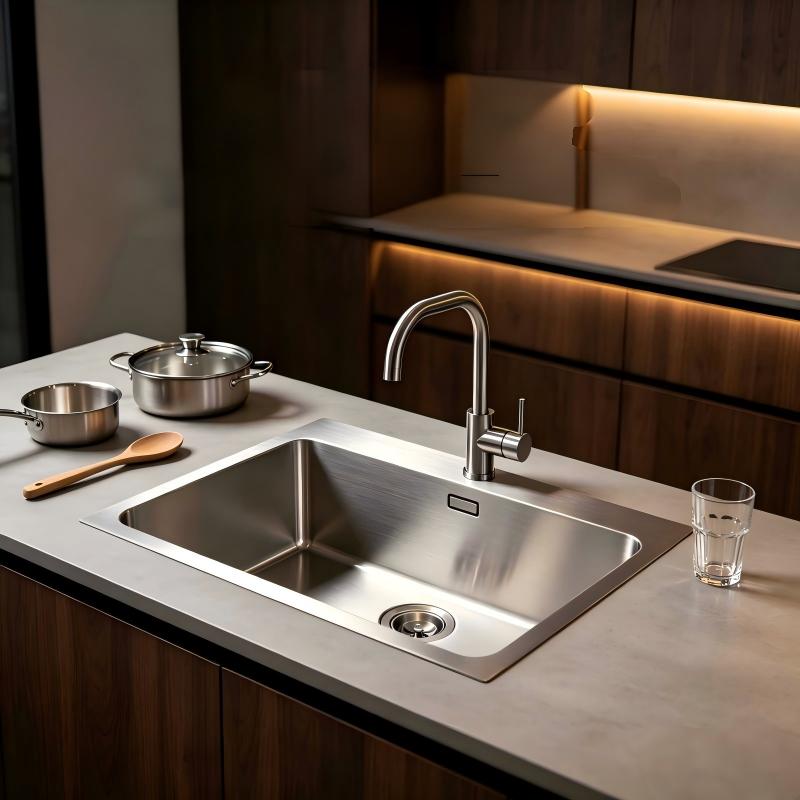
Understanding the value of handmade sinks begins with their manufacturing logic. The vast majority of ordinary sinks are produced using the deep-drawn process—like stamping a bowl shape out of a thin sheet of metal using a die. It’s efficient and low-cost.
The manufacturing logic for handmade sinks is fundamentally different. It’s more akin to “forging.” It starts with a thick, high-quality stainless steel sheet, which is then cut, bent, welded, and polished—assembled and “stitched” together piece by piece, much like crafting a precision instrument.
This fundamental difference gives handmade sinks superiority across multiple dimensions. In the language of Sun Tzu’s Art of War, deep-drawn sinks are “engaging the enemy with conventional forces”—standardized products. Handmade sinks, however, represent an advanced solution that “wins by surprise.” They were designed from the outset to meet more demanding requirements.
The first striking feature of a handmade sink is its thickness. To maintain structural integrity during bending and welding, it must use steel plates that are 1.2mm to 1.5mm thick or more, corresponding to 16 or 18 gauge. In contrast, due to process limitations, standard deep-drawn sinks typically use plates no thicker than 0.8mm (20 gauge or thinner).
Do not underestimate this difference of a few tenths of a millimeter. In the world of steel, the lower the gauge number, the thicker the steel. A 16-gauge steel plate (approximately 1.59mm) is nearly twice as thick as a 22-gauge plate (approximately 0.79mm). This translates into tangible benefits:
Professional procurement guides typically recommend 16 gauge as the heavy-duty commercial standard, with 18 gauge as the high-quality general standard.
Handmade craftsmanship offers designers and manufacturers a level of freedom simply unattainable with die-stretching processes.
The mature application of PVD nano-coating technology has elevated the design potential of handmade sinks to new heights. Through physical vapor deposition, surfaces can achieve stunning finishes like gunmetal, rose gold, and brushed copper, with surface hardness (8H pencil hardness), anti-fingerprint, and scratch resistance far surpassing that of standard stainless steel.
For B2B buyers, brand owners, and contractors, the advantages of handmade sinks translate directly into business benefits:
As a European brand partner commented during their collaboration with JSD: “The quality is consistently high, and their certifications (UPC, WRAS) give us confidence to sell in strict markets. Their flexible warehousing is a huge logistical advantage for us.”
Saying “handmade” doesn’t automatically guarantee high quality. Savvy buyers should focus on these specific details:
| Inspection Point | Specific Standard | Why It Matters |
|---|---|---|
| Steel Grade & Thickness | Verify it’s SUS304, with thickness of 16 or 18 gauge. | Determines durability, corrosion resistance, and noise reduction foundation. |
| Welding Quality | Check seams are smooth, uniform, with no pinholes or undercuts. | Precision laser welding is the guarantee of strength and aesthetics. |
| Surface Finish | Confirm a fine, uniform brushed finish or high-quality PVD nano-coating. | Impacts tactile quality, scratch resistance, and anti-fingerprint properties. |
| Basin Bottom Design | Basin floor should have proper slope for efficient, non-pooling drainage. | Essential for user experience and preventing stagnant water. |
| Soundproofing & Anti-Condensation | Ensure it has a high-quality EVA soundproofing pad and anti-condensation coating on the underside. | Determines noise levels during use and prevents cabinet moisture damage. |
| Accessories & Packaging | Check the precision of included accessories like grids and cutting boards; verify export-grade reinforced packaging. | Enhances overall value and ensures product safety during long ocean freight. |
The growing popularity of handmade stainless steel sinks isn’t a marketing gimmick. It represents a rational return to the fundamentals of materials science, manufacturing engineering, and user experience. With a more robust, precise construction, they powerfully answer the modern kitchen’s comprehensive demand for durability, quietness, safety, and aesthetics.
For procurement decision-makers, choosing a handmade sink is fundamentally choosing a “long-termist” supply chain strategy—opting for a marginally higher initial cost to secure years of reduced risk, enhanced reputation, and stronger market competitiveness. That is the true essence of the “hidden champion” philosophy.
Ready to integrate the quality story of handmade sinks into your product line? We’re here to support you with comprehensive ODM/OEM services, from concept to volume production—7-day prototyping, 30-day delivery, helping you effortlessly define the premium market.