Redefine your kitchen experience
Our handmade sinks are created by experienced craftsmen, and each piece is a unique work of art.

Yes—waterfall sinks can be a good choice when their broad rinsing outlet, usable basin and accessories suit the kitchen. But the waterfall effect alone does not prove better cleaning, lower water consumption or reliable performance. Those benefits depend on the complete sink system.
For importers, distributors and project buyers, the real question is whether a model delivers enough everyday value to justify its purchase price, installation requirements and after-sales support. An attractive demonstration can show the water curtain while leaving drainage, cleaning access and replacement parts unexplored.
A worthwhile waterfall sink should work well as an ordinary kitchen sink first. It should then add useful rinsing functions without making maintenance unnecessarily difficult. This guide explains how to assess that balance, what to check on a sample, and which specifications to settle before requesting a quotation.
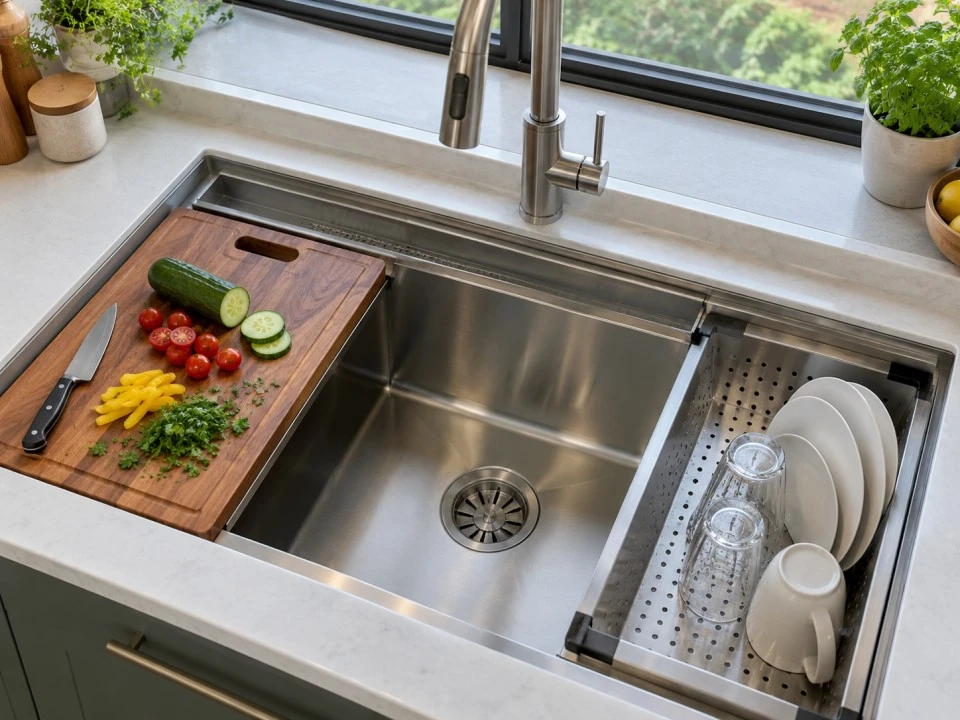
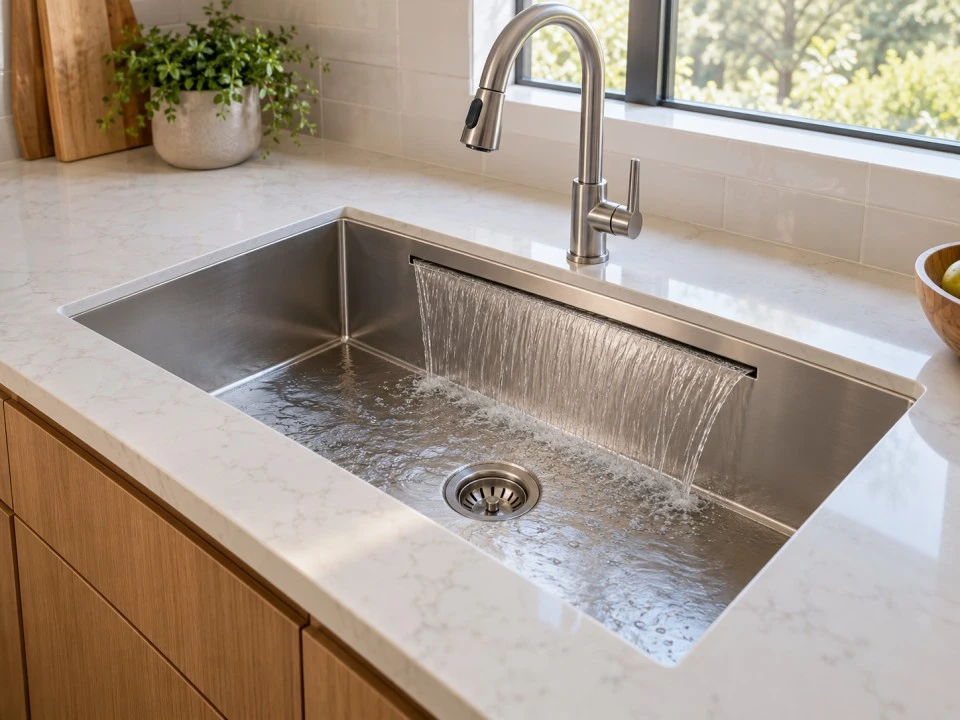
A waterfall kitchen sink incorporates a wide outlet that delivers water into the basin as a sheet or curtain. Depending on the model, the outlet may sit along the rear deck, form part of the faucet assembly, or operate alongside a conventional pull-out faucet.
Many models also include workstation ledges, sliding accessories, cup rinsers or multiple water modes. These are separate features. A sink does not need a display or a cup washer to qualify as a waterfall sink.
The terminology can be confusing. “Waterfall” usually describes incoming water, but some product listings use the term in drainage descriptions. Buyers should request a plumbing diagram showing where water enters, how modes are selected, and where wastewater exits.
JSD’s waterfall kitchen sink range provides a starting point for comparing configurations. Evaluate each model’s documented components rather than assuming every product in the category has the same functions.
A wide water curtain can be convenient for rinsing items held across its path, such as vegetables in a suitable basket or a flat tray. Its value depends on where the curtain lands and whether the user can position items comfortably.
Coverage and cleaning force are different qualities. A broad outlet distributes water across a wider area; that does not establish its ability to remove stubborn food residue. A directional spray remains useful for reaching corners and rinsing cookware.
During evaluation, try actual kitchen tasks. A visually even curtain is encouraging, but cleaning performance matters more than its appearance.
Sliding boards, colanders and drying racks can move some preparation work above the basin. That can be useful where countertop space is limited.
This benefit comes from the workstation layout. Buyers can obtain similar accessory functions in a workstation sink without a waterfall outlet.
Check whether accessories remain stable, leave enough room for cookware and allow access to the faucet. A crowded accessory package can reduce usable bowl space.
A waterfall outlet creates a visible point of difference that showroom staff can demonstrate quickly. For distributors, that can support a product range aimed at customers seeking more functionality and coordinated styling.
The commercial case still needs validation. Test customer interest through a limited launch or showroom trial before committing to a large order. A striking demonstration does not establish repeat demand or acceptable warranty costs.
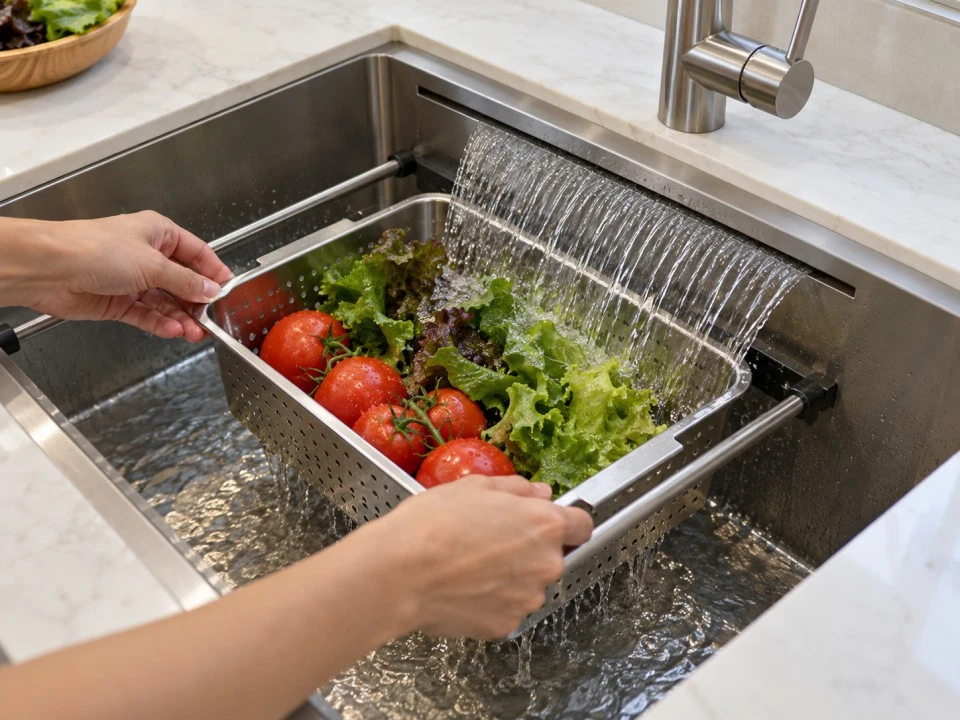
The useful comparison is between complete configurations, rather than between “modern” and “basic” products.
| Decision criterion | Waterfall sink system | Conventional workstation sink | What buyers should verify |
|---|---|---|---|
| Broad rinsing | Dedicated sheet-flow outlet on equipped models | Depends on faucet or spray head | Coverage at the intended operating pressure |
| Directional cleaning | Often provided by an additional pull-out faucet | Provided by the selected faucet | Reach, docking and spray effectiveness |
| Preparation accessories | May include boards, baskets and racks | Can offer similar accessories | Stability, fit and usable bowl space |
| Cleaning access | Extra outlets and controls may need attention | Depends on faucet and ledge design | Access to channels, strainers and removable parts |
| Installation | Integrated systems may add hoses and connections | Separate sink and faucet can allow more component choice | Cabinet clearance and connection layout |
| Repair flexibility | Depends on availability of model-specific parts | Separately replaceable components may simplify repair | Cartridge, hose and control compatibility |
| Purchasing cost | Includes the selected water functions and accessories | Depends on sink and faucet combination | Compare equivalent bills of materials |
| Best purchasing rationale | Broad rinsing plus useful, serviceable features | Workstation utility with a simpler water system | Match functions to the target customer |
A well-supported waterfall system can be a sensible purchase. A simpler workstation sink can also be the stronger choice when the extra outlet adds little value for the intended customer.
An integrated model may contain several valves, hoses, seals and controls. Each needs a defined replacement procedure.
Complexity does not prove poor quality. It does mean procurement must assess more than the stainless steel bowl.
Before approving a model, ask whether a technician can replace a leaking hose or faulty selector without removing the entire sink. Request an exploded drawing and part numbers. “Spare parts available” is less useful than a priced list with delivery commitments.
The U.S. Geological Survey’s explanation of water hardness identifies dissolved calcium and magnesium as the main contributors. USGS classifies water above 180 mg/L as calcium carbonate as very hard and describes mineral deposits in plumbing and fixtures.
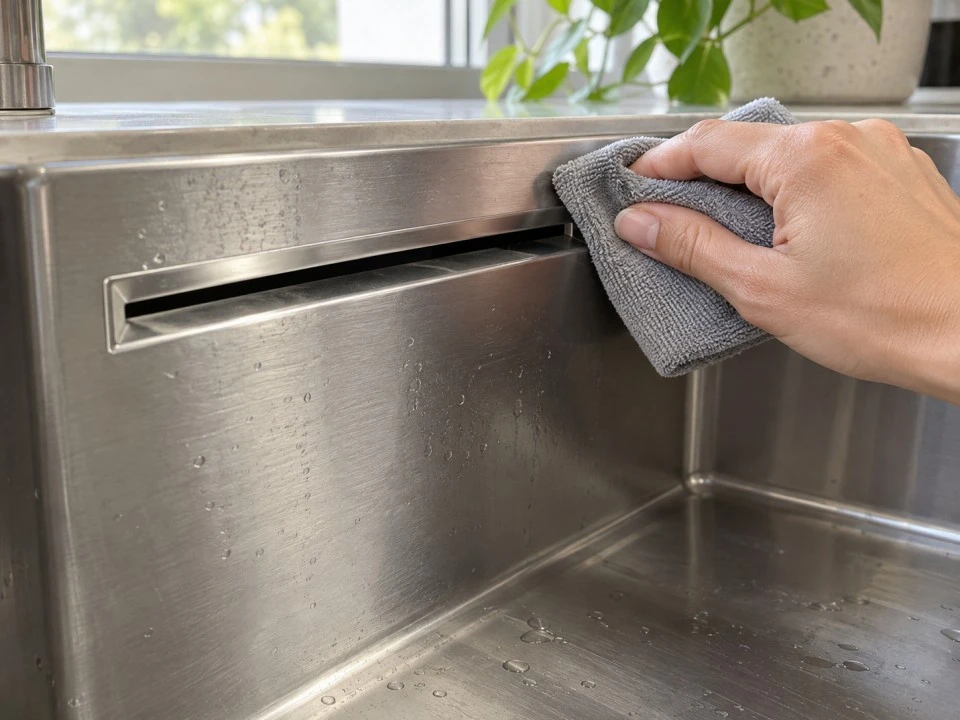
For waterfall sink sourcing, the practical implication is to examine how the outlet can be cleaned if deposits accumulate. Ask whether the outlet cover is removable, which cleaning agents are permitted, and whether maintenance requires special tools.
Do not assume a generic descaler is compatible with every colored finish, seal or coating. Obtain model-specific care instructions.
Waterfall flow and wastewater drainage are separate systems. A good-looking water curtain cannot compensate for standing water, awkward corners or a badly positioned drain.
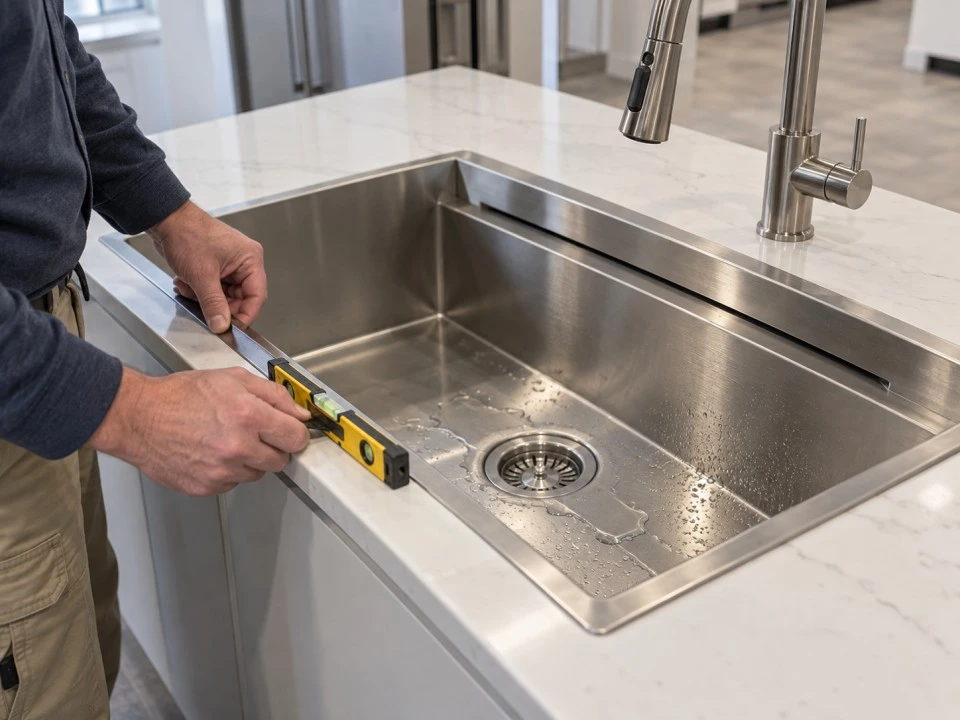
Check drainage with the sink installed level and with its intended waste assembly. Observe where water remains after flow stops. Then test whether loose food particles can be directed into the strainer without excessive rinsing.
A thin residual film and a persistent puddle are different conditions. Agree how drainage will be evaluated before accepting production samples.
The advertised sink width does not establish the required cabinet width, cutout dimensions or clearance behind the controls.
JSD’s 30-inch waterfall kitchen sink configuration is an example of a product marketed with several functions. Buyers should still obtain its dimensioned drawing, mounting instructions and under-sink layout before specifying it for a project.
Check the hose travel, drain position, mounting hardware and room needed for maintenance. Accessory-rich models deserve a physical installation trial.
A waterfall sink is not inherently water-saving or water-wasting. Consumption depends on the measured flow rate, operating time and whether outlets can run together.
Ask suppliers for flow data for each mode at stated inlet pressures. Also establish whether the selector allows simultaneous operation.
The calculation is straightforward:
Water used = flow rate × operating time.
As an illustrative example, an outlet running at 6 liters per minute for two minutes uses 12 liters. If a task takes longer under that outlet, any apparent efficiency advantage may disappear.
For U.S. product positioning, the EPA’s guidance on ineligible WaterSense products lists kitchen faucets as ineligible for the WaterSense label and recommends an efficiency criterion of 1.8 gallons per minute or less. That recommendation does not establish certification or compliance for a particular waterfall system.
Evaluate water use and task performance together. A low flow figure is useful only if the system still performs the intended job satisfactorily.
If a supplier specifies 304 stainless steel, request material documentation tied to the ordered product and agree how incoming material will be verified.
Also distinguish bowl thickness from rim or deck thickness. A single headline thickness may not describe every part of the sink.
Material selection is only one part of quality. Inspect weld finishing, edges, mounting surfaces and basin geometry on the actual sample.
An antibacterial description should identify the tested surface, test method, organisms, conditions and results. It should also explain whether performance remains after cleaning or wear.
For a listing such as JSD’s 304 kitchen sink marketed with an antibacterial claim, request the supporting report before repeating that claim in distributor literature.
The product name alone does not demonstrate antibacterial performance. Nor should such wording imply that ordinary cleaning is unnecessary.
“Black,” “nano” and “scratch-resistant” do not provide a complete finish specification.
Ask for the coating process, approved cleaners, warranty exclusions and agreed appearance standards. Compare samples for color, surface uniformity and cleaning behavior.
Avoid promising that a finish cannot scratch. Instead, establish what performance has been tested and how customers should maintain it.
Smart controls are worth considering when they improve a task the customer performs regularly and can be serviced economically.
Separate temperature indication from temperature regulation. A display showing water temperature does not, by itself, demonstrate thermostatic control or protection against scalding.
For JSD’s waterfall sink with a smart faucet and multiple water modes, buyers should confirm the control mechanism, power arrangement, operating limits and replacement procedure for the exact supplied version.
Ask what happens if the display fails. Can the normal faucet still operate? Can the display module be replaced independently? Are buttons clearly labeled, and does the user know which mode is active?
These questions are more useful than counting functions. An extra feature earns its place when the benefit exceeds the added cleaning, installation and repair burden.
One Reddit discussion about multifunction kitchen sinks began with a shopper who had seen repeated advertising but struggled to find reviews from people who had purchased the products. This is a qualitative example of a buyer’s evidence gap, rather than proof of product failure.
The sourcing lesson is practical: demonstration videos should be supported by installation information, service documentation and meaningful sample trials.
A relevant purchasing scenario is a distributor comparing two visually similar systems. One supplier provides clear part numbers and a replaceable outlet assembly. The other offers a lower price but cannot explain how repairs are handled.
That is a hypothetical comparison, not a reported customer case. It shows why repairability belongs in the purchasing decision before the first warranty claim arrives.
Treat the following as a proposed acceptance framework. Exact conditions and limits should be agreed with the supplier.
Use the intended mounting method, cabinet layout, faucet assembly and drain components. Check clearances and access for future repairs.
Record any additional adapters or fittings needed. Those items affect installation cost and should appear in the commercial specification.
Evaluate each mode at the supplier’s documented operating limits and at conditions representative of the destination installation.
Check curtain consistency, coverage, splash behavior and mode switching. If simultaneous operation is possible, test that condition separately.
Record pressure and flow together. A video without test conditions is difficult to compare with another sample.
Rinse a tray, wash a large pan, move accessories and direct loose particles toward the strainer.
Observe whether the waterfall adds convenience, whether the pull-out faucet reaches the whole bowl, and whether controls remain accessible during use.
Observe residual water after shutoff. Inspect supply connections, selectors and waste joints during use and afterward.
Repeat the agreed inspection after operating the controls. Record the method and duration rather than relying on a verbal assurance that the system was checked.
Remove the strainer, clean the waterfall outlet using approved instructions and attempt a representative component replacement.
Measure the practical effort involved. A service procedure that requires unusual tools or extensive disassembly needs consideration before bulk purchasing.
For a design-led model such as JSD’s cascade fountain sink with an integrated waterfall, confirm the actual material and intended application before testing. Its published descriptions reference different materials, so the approved drawing and written specification should resolve that ambiguity.
Request documents for the exact ordered configuration. A factory-level certificate or a report covering another faucet does not establish the performance of the supplied assembly.
For drinking-water-contact components, NSF’s explanation of NSF/ANSI/CAN 372 states that the standard addresses lead content only. It identifies a maximum weighted lead content of 0.25% for most components and distinguishes this from extraction or leaching evaluation, such as NSF/ANSI/CAN 61.
Use that distinction when reviewing documentation. A lead-content statement should not be presented as proof of every aspect of water-contact safety or complete product performance.
Ask for applicable destination-market documentation, model identification, installation instructions, care guidance, component drawings and warranty terms. Have the relevant certification body or local professional confirm which requirements apply to the intended market and installation.
A useful RFQ defines the complete deliverable, including accessories and service support.
| RFQ field | Information to provide or request |
|---|---|
| Application and market | Residential use, sales channel and destination country |
| Dimensions | External size, bowl size, depth, cutout and minimum cabinet requirements |
| Installation | Mounting method, countertop details and required hardware |
| Material and finish | Steel grade, thickness by component, coating and approved appearance sample |
| Water functions | Required outlets, controls and simultaneous-use behavior |
| Operating conditions | Pressure range, flow by mode and hot-water limits |
| Connections | Supply threads, hoses, drain interface and required adapters |
| Accessories | Itemized list, materials, dimensions and fit requirements |
| Quality acceptance | Agreed flow, drainage, leak, appearance and packaging checks |
| Documentation | Applicable reports, drawings, manuals and model traceability |
| Commercial terms | Quantity, MOQ, customization, lead time, shipping terms and destination |
| After-sales support | Warranty scope, spare-part prices, availability and replacement instructions |
Compare quotations on the same bill of materials. A price including a faucet, cup rinser and accessory set is not directly comparable with a bowl-only quotation.
Then assess total landed cost, installation effort and expected service expense. As a purchasing framework:
Expected service expense = estimated claim frequency × average cost per claim.
Use pilot-order results or your own sales history for those inputs. Do not substitute an assumed industry failure rate.
They can be worthwhile when broad rinsing, a usable workstation layout and coordinated controls serve the intended customer. Buy on demonstrated performance and service support. The waterfall effect alone does not justify a premium over a well-designed conventional sink.
The required pressure depends on the outlet and control design. There is no universal minimum for the category. Request the model’s operating range and flow data, then test the water curtain at conditions representative of the intended installation.
Cleaning difficulty depends on access to the outlet, accessory ledges, corners and strainers. Prefer designs with clear maintenance instructions and accessible parts. Hard-water locations deserve particular attention to approved descaling methods and outlet cleaning.
Not automatically. Incoming waterfall flow does not establish wastewater drainage performance. Evaluate the installed basin, drain assembly and residual pooling separately. Ask for a drainage demonstration using the actual supplied components.
No. Temperature indication and temperature regulation are separate functions. Request documentation describing the mixing mechanism and control behavior. Do not infer anti-scald protection from the presence of a display.
Prioritize the exact cartridges, selector valves, seals, hoses, spray heads and electronic modules used in the selected model. Obtain part numbers, prices and replacement instructions. Choose initial stock levels from supplier guidance and pilot-order experience.