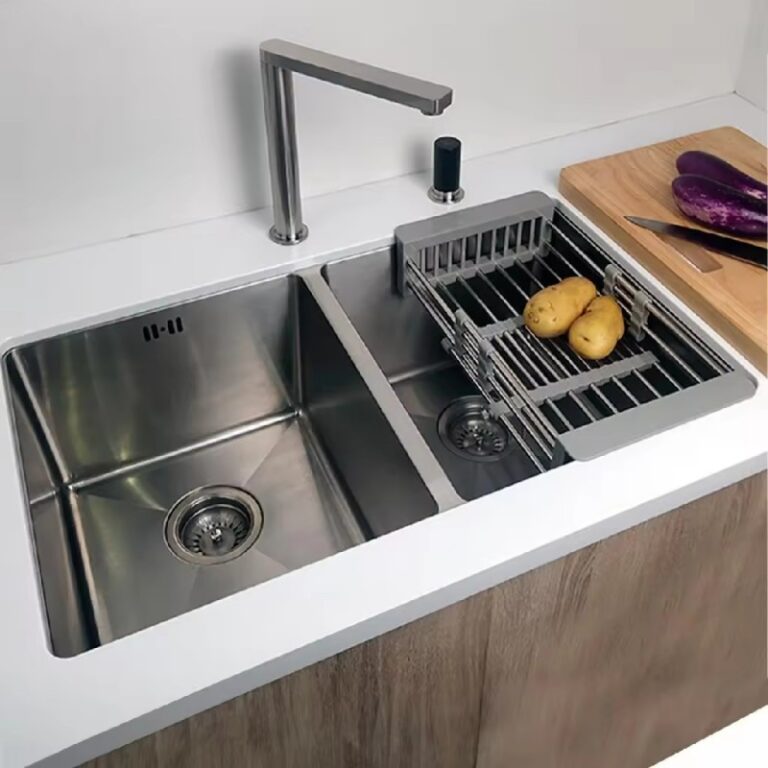
Redefine your kitchen experience
Our handmade sinks are created by experienced craftsmen, and each piece is a unique work of art.

Most people only realize what a “bad sink” is after they’ve lived with one.
It’s not the look that bothers you—it’s the feeling over time. The sharp noise when water hits the steel. The damp smell under the cabinet that doesn’t go away. The quiet suspicion that something is slowly deteriorating where you can’t see it.
Here’s the uncomfortable truth:
Two sinks can look almost identical on the surface, yet behave completely differently after six months.
Why? Because real quality lives underneath.
If you strip away branding, pricing tricks, and surface finishes, it often comes down to two overlooked details:
how the sink handles vibration and how it handles moisture.
That’s where sound silencer pads and anti-condensation coatings stop being “features” and start being deciding factors.
A sound silencer pad is often described as a noise-reduction layer. That’s technically correct—but incomplete.
In reality, it’s a control system for energy.
Every time water hits a stainless steel sink, it transfers kinetic energy into the metal. That energy becomes vibration, and vibration becomes noise. Cheap sinks simply amplify it. Better sinks absorb it.
The pad is what decides which one you get.
A thin, poorly attached pad doesn’t really “silence” anything—it just slightly softens the problem. A well-designed pad, on the other hand, changes the entire character of the sink. The sound becomes dull, controlled, almost unnoticed.
You stop thinking about it. And that’s the point.
Yes, it reduces noise—but more importantly, it changes how the sink feels to use.
A loud sink creates a subtle kind of stress. You don’t always notice it consciously, but in open kitchens or small apartments, it adds up. Conversations pause. Background comfort drops.
A well-damped sink does the opposite. It blends into the environment. It behaves more like ceramic than metal.
That shift—from reactive to quiet—is what separates “acceptable” from “premium.”
Here’s where things get more interesting.
Metal reacts quickly to temperature. Pour hot water into a cool sink, and the underside becomes a perfect place for condensation to form. Over time, those tiny droplets turn into a pattern: dampness, then staining, then potential damage.
The silencer pad slows this entire process down.
Not completely. Not magically. But enough to reduce the frequency and severity of condensation cycles. Think of it as buying time—and in materials, time is everything.
This isn’t usually advertised, but it shows up in daily use.
Less vibration means water behaves more predictably. It doesn’t scatter as aggressively. That means fewer micro-splashes, fewer water spots, and less buildup around the sink edge.
In higher-end designs, some pads also resist microbial growth. Not a headline feature—but one of those quiet details that matter after months, not days.
If you really want to judge a sink, don’t look at the finish—look at the pad.
There’s a pattern in the market:
Because here’s the real issue:
A pad doesn’t fail on day one. It fails after heat, humidity, and years of expansion and contraction.
That’s why better manufacturers move toward engineered polymers—materials that don’t harden, crack, or release odor over time.
So the real question isn’t “what material is used?”
It’s: what will this material feel like after three years under a sink?
If the silencer pad is about controlling energy, the anti-condensation coating is about controlling environment.
It’s applied to the underside of the sink, forming a thin but critical barrier between metal and air.
Without it, the sink is exposed. Every temperature change, every humidity shift, every seasonal variation—directly affects it.
With it, those changes are moderated.
It doesn’t eliminate moisture. It manages it.
And that distinction matters.
Condensation is rarely dramatic. It’s slow, repetitive, and easy to ignore—until the damage becomes visible.
A good coating interrupts that cycle.
It reduces how easily droplets form, and more importantly, how they accumulate and drip. Over time, this protects not just the sink, but everything around it—especially wooden cabinets that are far less forgiving than steel.
Cleanliness isn’t just about what you wipe—it’s about what never builds up.
Moisture is the starting point for most hidden problems: odor, bacteria, residue. By keeping the underside drier, the coating quietly prevents these issues from developing.
You may never notice it working.
But you’ll notice when it’s missing.
What’s interesting about Chica stainless steel sinks isn’t that they include these features—it’s how they treat them.
In many products, sound pads and coatings feel like afterthoughts. Added just enough to check a box.
Here, they’re integrated into the structure.
The pad placement is deliberate, not random. The coating coverage is consistent, not partial. The goal isn’t just to include these elements—but to make sure they still perform after real use, not just factory testing.
It’s a subtle difference. But in practice, it’s what separates a sink that starts good from one that stays good.
A quality sink doesn’t impress you on day one. It proves itself over time.
Less noise. Less moisture. Fewer problems you have to think about.
Sound silencer pads and anti-condensation coatings are easy to overlook because they don’t sell visually. But they define how the sink behaves in the real world.
And ultimately, that’s what people live with—not the finish, not the brand, but the experience.
If you want to choose better, don’t just ask how a sink looks.
Ask how it handles the things you can’t see.
Q1: Why do some sinks still feel noisy even with pads?
Because not all pads are designed to absorb vibration effectively. Thickness alone doesn’t guarantee performance.
Q2: Is condensation really a long-term issue?
Yes—but it’s gradual. Most damage happens quietly over time, not all at once.
Q3: Can I check these features before buying?
Yes. Turn the sink over. Look at coverage, material quality, and consistency. That tells you more than the surface ever will.
Q4: What’s the biggest mistake buyers make?
Focusing too much on appearance and not enough on how the sink behaves after daily use.