Redefine your kitchen experience
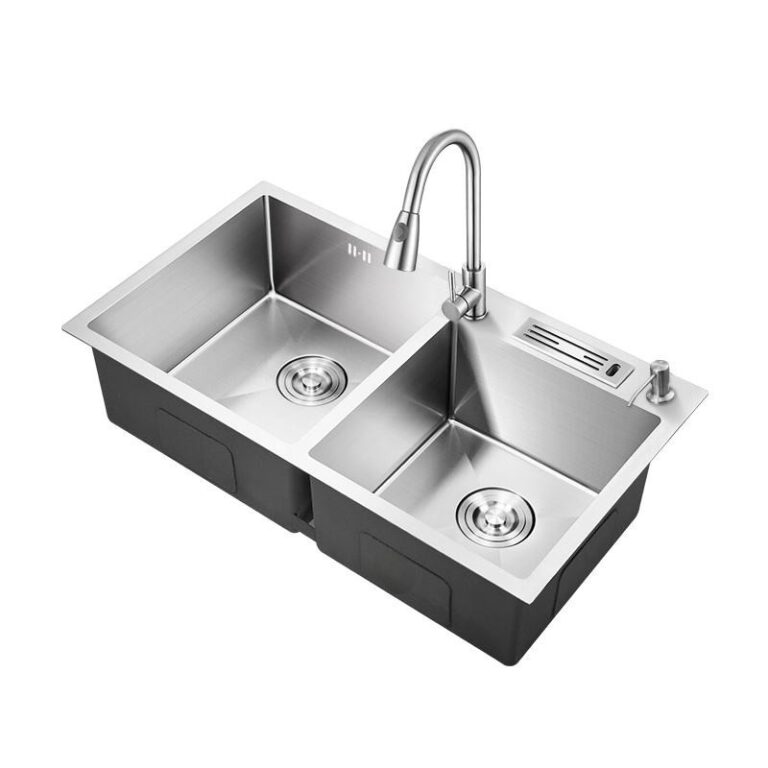
Our handmade sinks are created by experienced craftsmen, and each piece is a unique work of art.

Intro — quick answer up front
Short version for purchasing managers: the terms laundry sink and utility sink are often used interchangeably by homeowners and retailers, but for a buying/procurement decision they carry different expectations. A laundry sink normally refers to a dedicated basin used primarily in laundry rooms for soaking, hand-washing and washing-machine discharge tasks; a utility sink is a broader category—heavy-duty, multi-purpose basins used in garages, workshops, janitorial closets and commercial back-of-house spaces. Treating them as distinct product lines (different depths, materials, rough-ins and accessories) helps you match SKUs to channels and avoids costly returns. For manufacturers and buyers sourcing directly from professional sink factories like JSD Sinks, this distinction is especially important at the SKU and channel-planning level.
Subtitle: depth, bowl shape and mounting decide the use case
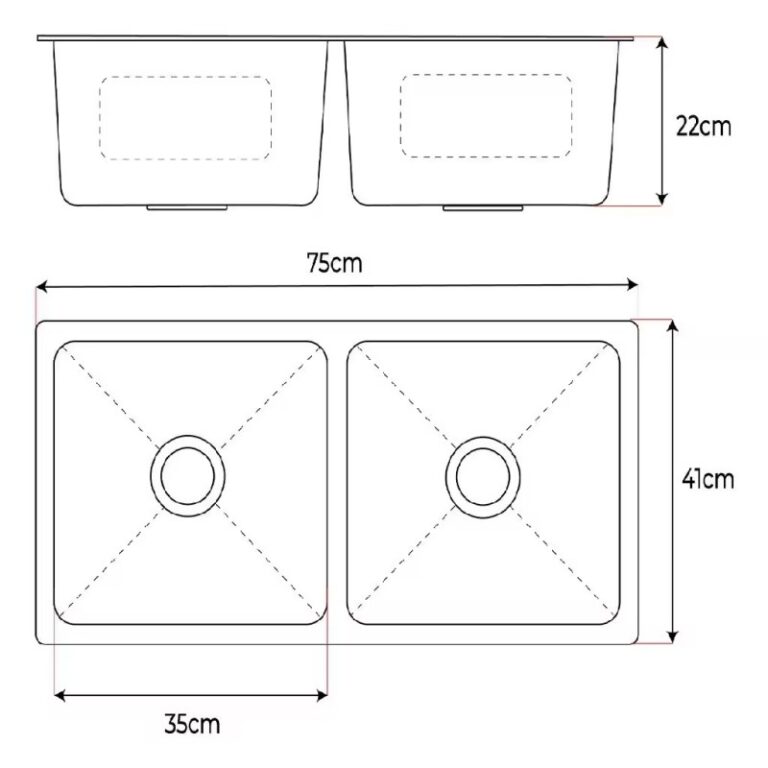
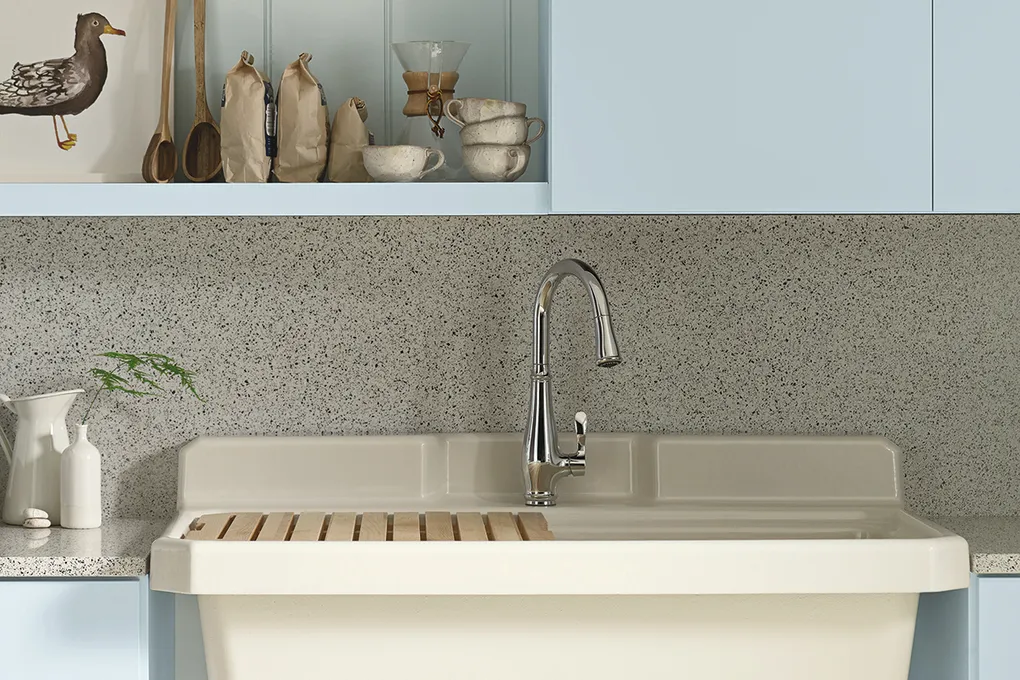
Laundry sinks usually have deeper bowls (commonly 10–12″ or more) with smooth corners for soaking and rinsing, and they are often offered in finishes that blend with home laundry or mudroom décor — vitreous china, composite (granite/stone-like), and stainless steel. Utility sinks skew more industrial: larger footprints, extra-deep basins (sometimes 12–25″ in heavy-duty models), simple aesthetics, and configurations like one, two or three bowls for commercial use. From a merchandising point of view, position laundry sinks in home-improvement/mudroom assortments and utility sinks in janitorial/commercial or hardware assortments. Factories that already produce workstation sinks and heavy-duty stainless designs can often adapt those platforms for utility applications with minimal tooling changes.
Subtitle: load, chemicals, and extra tasks drive specification
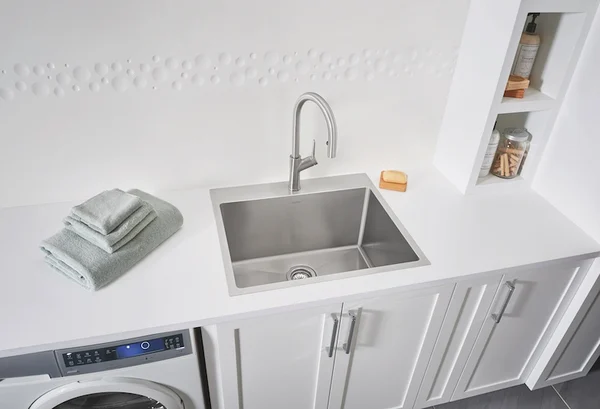
Laundry sinks are optimized for laundry tasks: soaking delicates, treating stains, occasional pet baths and as an indirect drain location for washers. Utility sinks are specified to survive harsher use—chemical rinsing, paint cleanup, mop dumping and repeated heavy objects. That affects material choice, thickness (stainless gauge), reinforcement, and accessory offerings (e.g., integrated drainboards, splash guards, heavy-duty faucets or hose bibs). For retailers and distributors, that means you should stock different accessory kits and warranty/return policies by product family. Many commercial buyers will also expect compatibility with standard sink accessories such as bottom grids, strainers, and drain kits to extend service life.
Subtitle: rough-in, drain size and code basics matter to installers and end users
Laundry/utility fixtures interact with washing machines and building drainage, so plumbing rough-ins are critical. Washing machine standpipes and laundry/utility connections are governed by plumbing codes: the standpipe for a washer must be individually trapped and normally extend between 18″ and 42″ above the trap weir (many codes specify 18″–30″ or 18″–42″ ranges depending on the standard), and trap/vent sizing and placement must follow local UPC/IPC rules. That means your product line must include options or clear install guidance for sink-to-standpipe tie-ins, appropriate waste openings, and where necessary a 2″ line for combined loads. If you supply sinks without clear plumbing notes, installers will call—and buyers will demand exchanges. From a sourcing perspective, factories experienced in undermount sink and topmount production tend to provide clearer rough-in documentation.
Subtitle: choose material and gauge to match expected use
Common materials and where to use them:
For wholesale assortments: offer a baseline stainless 18-gauge utility model plus a premium 16-gauge SKU and one decorative vitreous/composite laundry sink. That three-tier approach simplifies ordering and cross-selling (accessories, faucets, cabinets). Many suppliers already offering durable 304 stainless steel sinks with multiple thickness options can cover all three tiers efficiently.
Subtitle: kits sell better than lone bowls
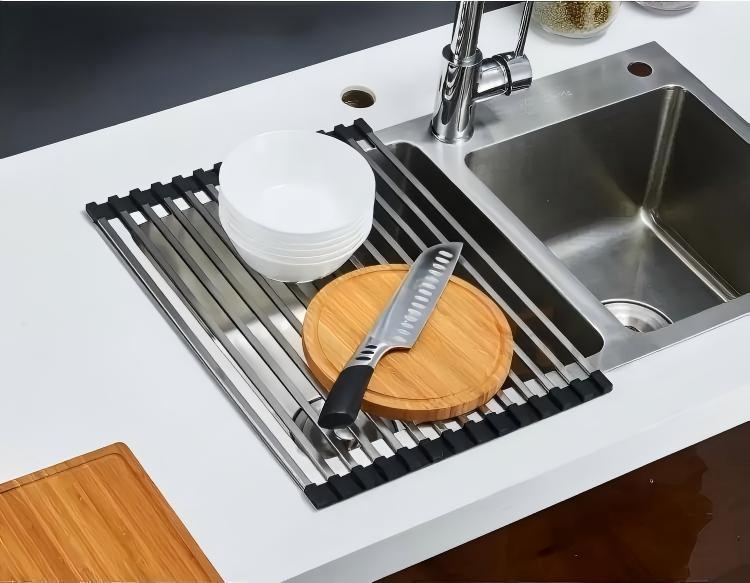
Laundry customers value splash-resistant faucets, built-in soap ledges, and integrated shelving or drying racks. Utility buyers want hose adapters, floor-mount or wall-mount brackets, drain strainers and anti-splash splash guards. Make accessory bundles (e.g., sink + heavy-duty faucet + grate + trap) the default for distributors—bundles reduce SKU confusion and increase average order value. This approach mirrors the success seen in workstation-style sink systems, where accessories drive higher per-order revenue.
Subtitle: pick anchors and a private label strategy
Below are real market examples (useful when comparing specs and margins):
How to position them in your catalogue:
Subtitle: reduce friction and returns with a standard QA list When evaluating suppliers or placing orders, require and record:
Subtitle: win large channel listings with clarity and flexibility If you’re selling factory-direct (or pitching your factory to wholesalers): offer clear B2B SKUs that map to retail SKUs (e.g., P-LAV-SS16 for 16-gauge stainless laundry tub; P-UTIL-STN for stainless utility double bowl). Provide:
| Feature | Laundry sink (home) | Utility sink (commercial/utility) |
| Typical depth | 10–12″+ | 12–25″ (or multi-bowl) |
| Typical materials | Vitreous, composite, SS | Heavy-gauge SS (16–18GA), composite |
| Use cases | Soak/delicates, pet wash | Mop buckets, paint cleanup, heavy tools |
| Installation notes | Can be cabinet or wall mounted | Often wall mount or floor support; allow larger drain/standpipe |
| Typical buyer | Home centers, retail | Contractors, janitorial, foodservice |
Subtitle: differentiation and low-risk ordering win the deal
Subtitle: a small change in SKU strategy drives fewer returns and higher margins Position laundry sinks and utility sinks as two complementary product families rather than synonyms. For wholesalers and supermarket buyers this means clearer merchandising, fewer installation problems, and better margin control: carry at least one baseline stainless utility model (18GA), one premium stainless (16GA) and one decorative laundry model (vitreous or composite). Back each SKU with spec sheets, plumbing notes, certification files and a sample policy — that’s the professional, factory-grade approach buyers trust and reorder.